

The short version
Almost every slab problem in Dallas is a repair, not a replacement.
Underpinning addresses the usual situation: the concrete is broadly sound and the soil beneath it has moved. Piers transfer the load to material that does not move seasonally, and the structure is lifted back toward a target elevation.
Replacement addresses a fundamentally different situation: the slab itself has failed structurally, or was built in a way that cannot support a durable repair. That is genuinely rare in residential work.
If someone has proposed replacement, the question to ask is which measurements led there.
What repair involves
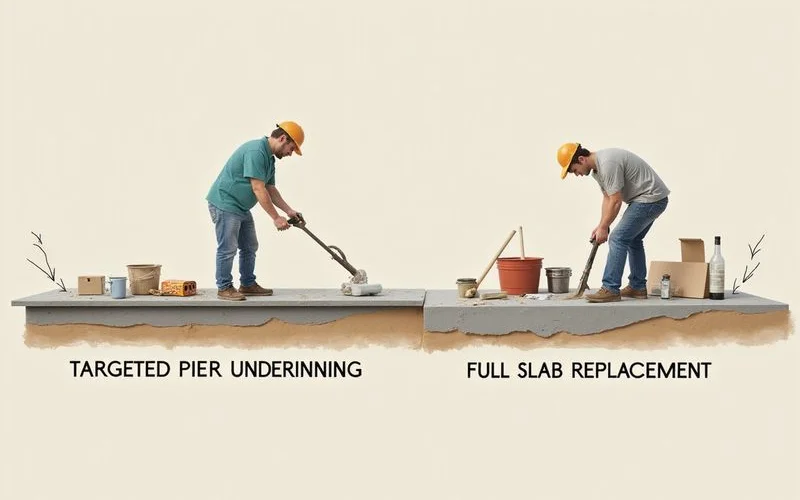
Slab foundation repair installs piers beneath the grade beams, drives them to material capable of carrying load, and transfers the building’s weight onto them.
The house stays where it is throughout. The slab stays in place. The soil that has been swelling and shrinking is no longer what the structure depends on. For the sequence that work actually follows, see what happens during slab foundation repair.
Typical duration: one to a few working days. The household usually stays in the home.
What replacement involves
Replacement means removing and rebuilding the foundation beneath an existing structure. The building has to be supported temporarily while its foundation is demolished and recast, then set back down.
Everything connected to the slab is affected: plumbing beneath it, the connection between the frame and the foundation, and every finish inside that assumes the floor is where it was. The household cannot remain in the property. Schedule runs in weeks, not days.
The cost difference is not incremental. It is a different order of project.
Criteria that favour repair
- The concrete is broadly sound. Cracking is present but the slab is not structurally disintegrated.
- Movement is localised. The elevation survey shows a corner, an elevation, or a bearing line has dropped rather than the whole plan being chaotic.
- The cause is soil movement. Which is the usual situation in expansive clay.
- Piers can reach adequate bearing. Nothing about the site prevents installing durable support.
That describes the overwhelming majority of Dallas-area cases.
Criteria that would point toward replacement
- Documented structural failure of the slab itself, not of the soil beneath it: extensive fracturing with displacement, reinforcement failure, or comprehensive deterioration.
- Original construction so deficient that underpinning cannot produce a reliable result.
- Damage from a catastrophic event rather than progressive movement.
- A change of use or a rebuild already planned that makes replacement rational for reasons beyond the foundation.
These conditions need to be established by evidence, and in practice that usually means an engineer’s assessment rather than a contractor’s recommendation alone.
What the evaluation determines
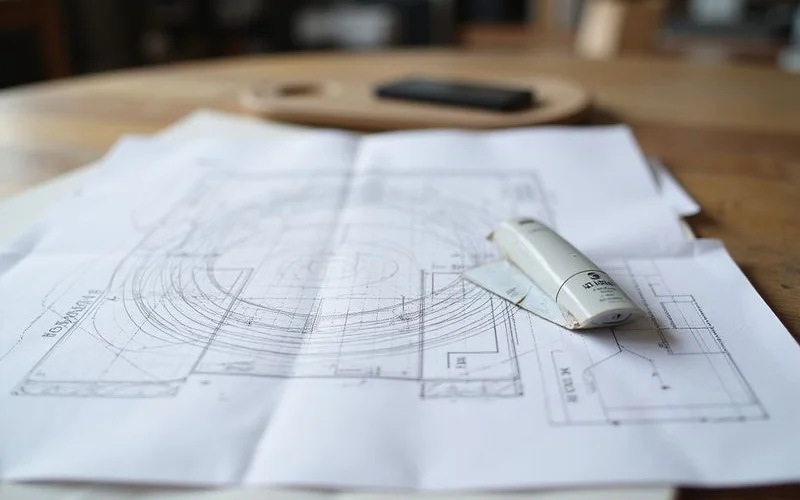
An evaluation produces the evidence that answers this question.
The elevation profile shows whether variance is localised or distributed. A single low corner points to targeted underpinning. Widespread, irregular variance with no coherent pattern is a different conversation.
The distress survey shows whether the cracking is in the walls, which is the structure responding to movement, or in the slab itself with displacement across the crack, which is the slab failing.
Site conditions show whether the cause is external: a plumbing leak, a drainage problem, or a mature tree drying the soil.
Why symptoms alone do not decide
Dramatic symptoms are not evidence of a failed slab. A house can have alarming cracking, badly sticking doors, and visibly sloping floors, and still be a straightforward eight-pier repair, because all of that is the structure responding to soil that moved.
Conversely, a slab with genuine structural problems may present modestly at first.
The correlation between how bad it looks and what it needs is weaker than intuition suggests, which is why measurement comes before diagnosis.
If replacement has been proposed
Ask for the elevation survey results. Ask what specifically about the slab, rather than the soil, rules out underpinning. Ask whether an engineer has assessed it, and if not, get one.
An independent structural engineer has no stake in the size of the job. On a recommendation of this magnitude, that independence is worth the fee several times over.