What drainage work does for a foundation
Soil around a Dallas foundation changes volume as its moisture content changes. That is what expansive clay does. The damage comes not from moisture itself but from the swing, and particularly from a swing that happens unevenly around the building.
Drainage work aims at the swing. Move concentrated water away from the structure, stop one elevation from sitting saturated while the other bakes, and the soil around the perimeter behaves more consistently. Consistent soil moves less. That protects a sound foundation and it protects a repaired one.
What drainage does not do is lift a foundation that has already settled. Where an evaluation documents real movement, structural repair is the corrective work and drainage is what keeps the correction from being undone. We treat the two as a pair on foundation repair projects in Dallas where moisture is driving the movement.
The measures we install
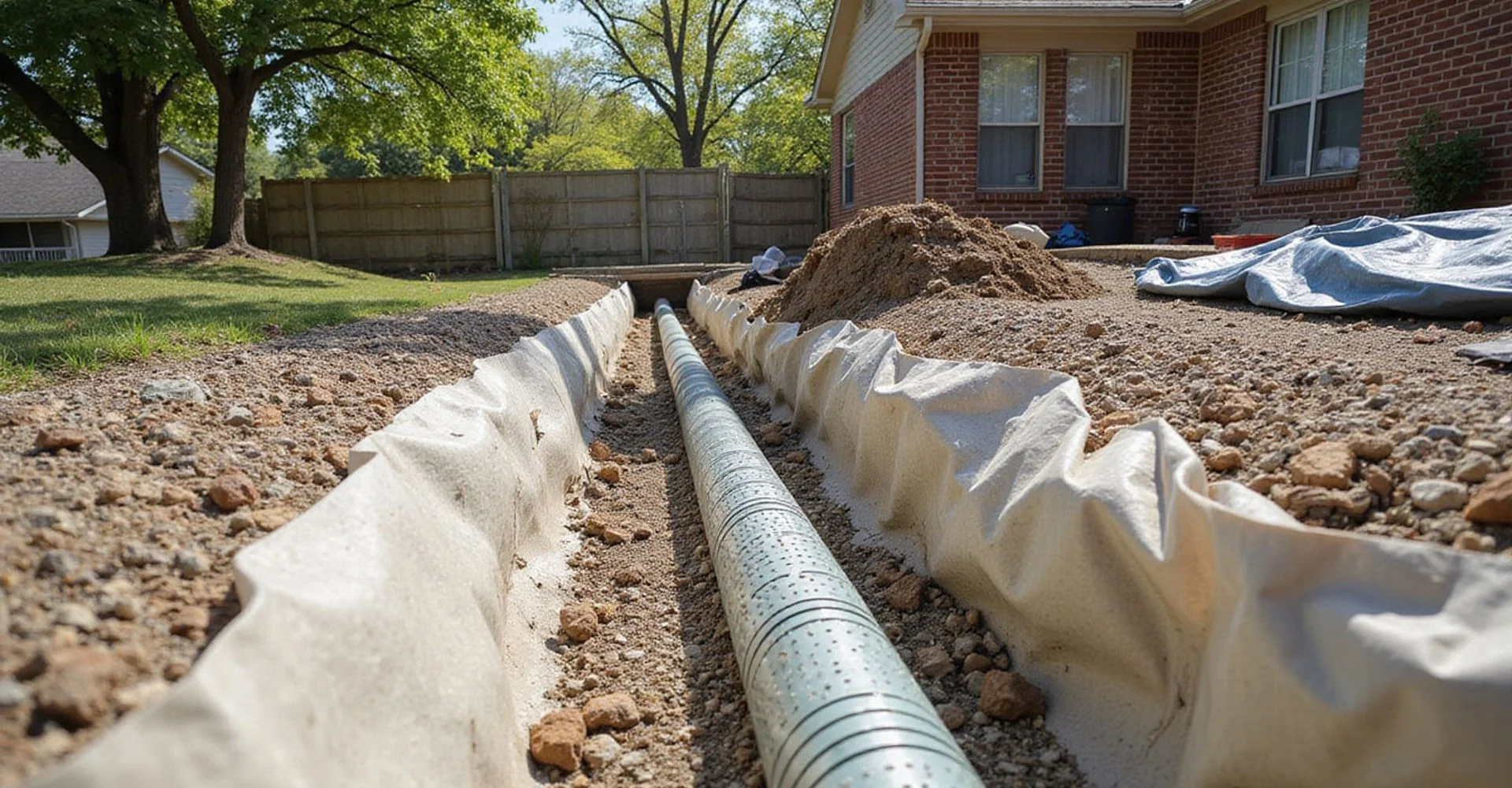
French drains. A trench lined with geotextile filter fabric, filled with clean gravel, containing perforated pipe that collects subsurface water and routes it to a discharge point. Suited to persistently saturated ground and slopes above the house.
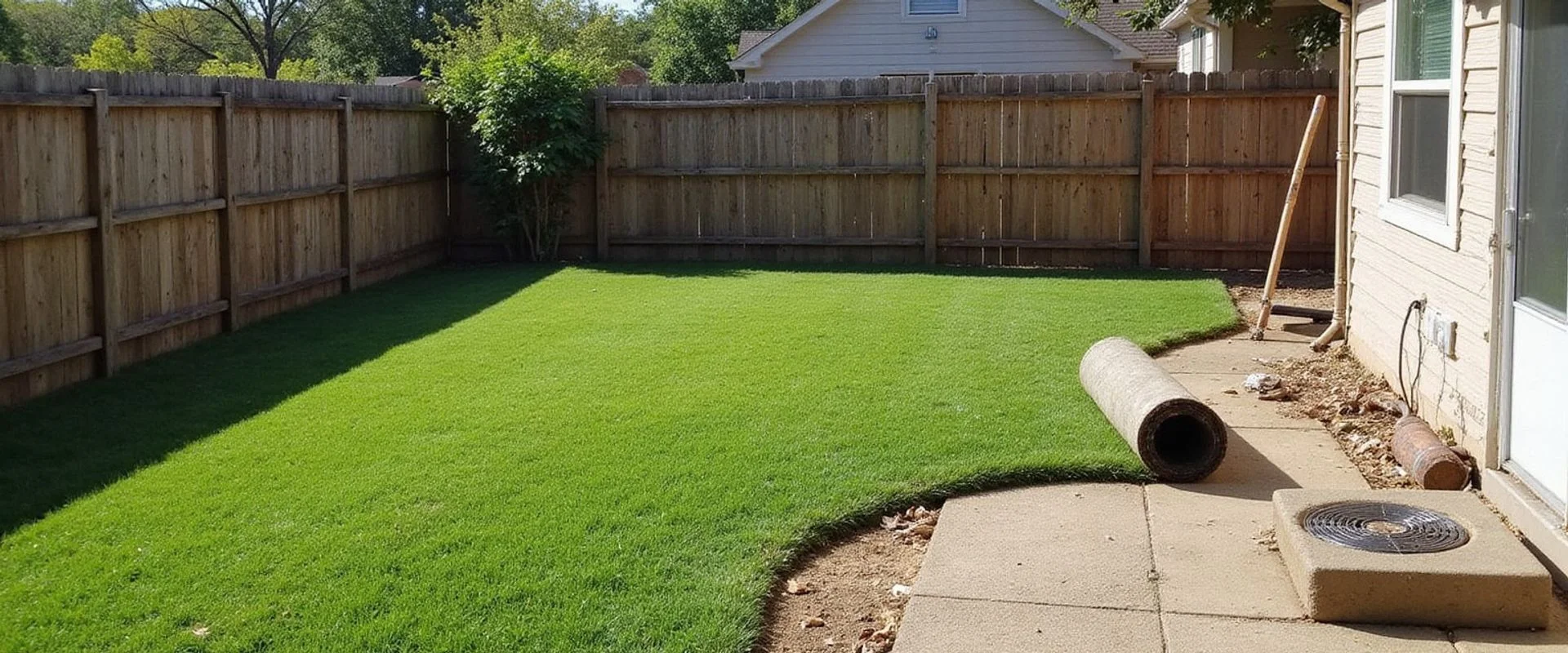
Catch basins and channel drains. Surface collection where water visibly pools, connected to solid line and carried to an outlet. Often the simpler and cheaper answer when the problem is surface runoff rather than subsurface saturation.
Swales and regrading. Shaping the ground to establish positive fall away from the house and to route surface water along an intended path. Frequently the highest-value intervention available and the one most often overlooked.
Downspout extensions and discharge lines. Roof runoff concentrated at a handful of points is a large volume of water. Getting it away from the foundation rather than discharging it at the wall is basic and effective.
Root barriers. HDPE panels installed vertically between a mature tree and the structure, deep enough to redirect the root zone away from soil beside the foundation.
Sump basins and pumps. Where gravity discharge is not achievable, which happens on genuinely flat lots.
Root barriers and Dallas trees
Live oaks, pecans, elms, and crepe myrtles are part of what makes established Dallas neighborhoods what they are, and homeowners are understandably reluctant to remove them.
They are also drawing a substantial volume of water out of the soil within their root zone. In clay, localized drying means localized shrinkage, which is why settlement is often concentrated on the side of a house nearest a large tree.
A root barrier addresses the mechanism without removing the tree. Panels are set in a trench between tree and structure, sized for the species and its root habit. It is less disruptive than removal, considerably cheaper than the structural repair that untreated desiccation can eventually require, and it keeps the tree. We present it before anyone suggests a chainsaw.
Discharge: the constraint that shapes everything
Every drainage design is limited by where water can lawfully and physically go. It must be lower than the collection point, on ground you control or into a legitimate outlet, and it must not create a problem on a neighbouring property.
On sloped lots in Oak Cliff this is usually straightforward. On flat lots in Plano or Garland the viable outlet can be a long run from the problem, and occasionally a sump and pump is the only design that works. We confirm the discharge before quoting the run, because a drain with nowhere to go is a trench that holds water against your house.
Maintenance is part of the system
Basins fill with leaves and silt. Outlets get overgrown or buried in mulch. Pop-up emitters jam. Perforated pipe silts up if fabric was omitted at installation, which is one reason we specify geotextile in the scope.
None of this maintenance is difficult, but it does have to happen. At handover we walk you through where the access points are and what clearing them involves, and we document the as-built run so a future owner is not guessing about what is buried in the yard.
What you receive
A written scope stating collection points, run length and depth, pipe and fabric specification, discharge location, restoration by surface type, exclusions, and maintenance requirements. Where the honest answer is a plumber, an arborist, or a landscape contractor rather than us, that is what the document says.
Our guide on how drainage affects your foundation covers the moisture-to-movement relationship in more depth.