

The carpentry side of pier-and-beam work
Not every problem under a raised foundation is a pier problem. A good share of them are carpentry: the wood carrying your floor has weakened, and no amount of adjusting supports fixes a member that has lost capacity.
This guide covers the three interventions that come up most often in pier-and-beam repair: sistering joists, repairing girders, and setting adjustable posts. For the symptoms that lead here in the first place, see signs your pier-and-beam foundation needs work.
Sistering joists
A joist spans between girders and carries the subfloor. Over decades it can deflect under load, split along the grain, lose bearing at an end, or soften where moisture has reached it.
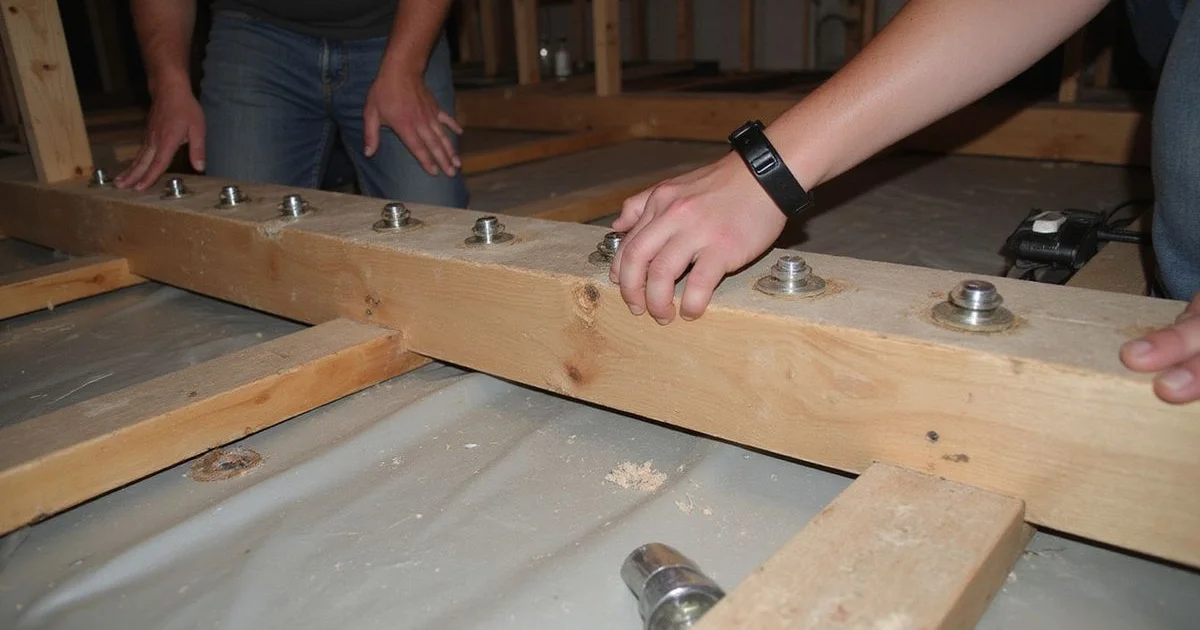
Sistering attaches a new member alongside the original, fastened along the span with through-bolts or structural screws at a specified pattern so the two act together. The new member picks up load the old one can no longer carry.
Done properly, the sister runs the full span and bears on the same supports at each end. A short section fastened over the sagging middle does not transfer load to anything and is essentially decorative.
When sistering works: the existing joist is still structurally present, bearing is sound at both ends, and there is room in the crawlspace to get the new member in.
When it does not: the joist end has rotted away, the member has failed comprehensively, or clearance makes installation impossible. In those cases replacement is the answer.
Girder and beam repair
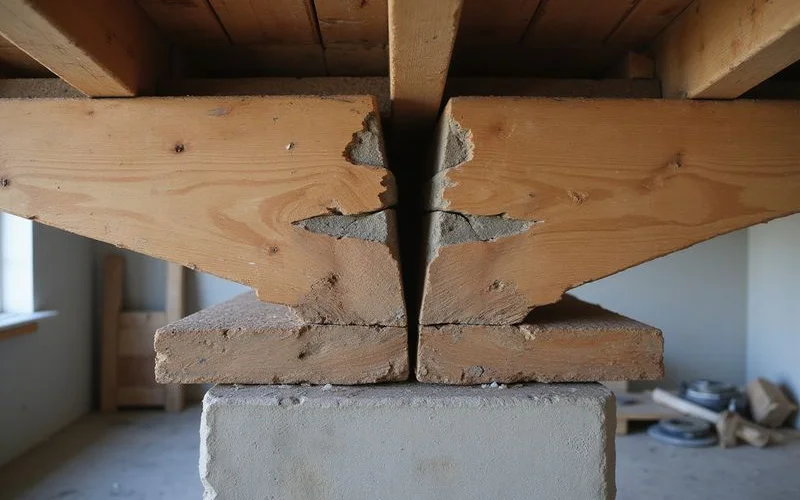
Girders carry more load than joists, so their failures are more consequential and the sag they produce usually follows a line rather than affecting one spot.
Common conditions: splitting along the grain, crushing where the girder bears on a pier, rot at a bearing point, and sagging between supports where spacing was always marginal.
The options, in ascending order of intervention:
- Improve bearing. Sometimes a girder is sound but the pier beneath it has settled or the bearing area is inadequate. Correcting the support resolves the sag.
- Add a support. Reducing the span by introducing a new pier and footing between existing ones.
- Reinforce. Sistering the girder with additional material along the affected length.
- Replace a section. Cutting out a rotted or failed length and splicing in new material over proper bearing.
- Full replacement. Where the member has failed along its length.
Each of these is a genuinely different price, which is why a scope that just says “beam repair” is not telling you much.
Adjustable steel jack posts
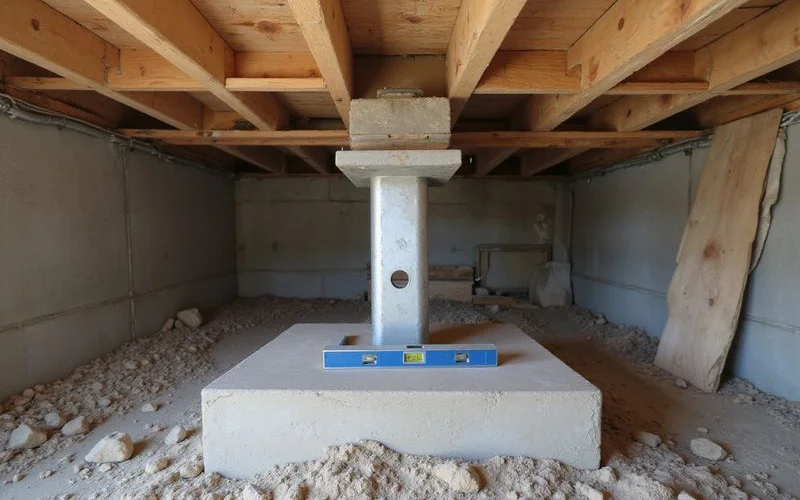
An adjustable steel post is a threaded column that can be set to a precise height and adjusted later if needed. Used properly they are an excellent tool for supporting a girder at a monitored elevation.
Their reputation suffers because of how often they are installed badly: dropped onto bare soil, onto a loose paving slab, or onto a footing far too small for the load. A post on inadequate support settles with the soil, and the floor comes back down.
The detail that matters is the footing. A poured concrete footing sized for the load, bearing on suitable material, with the post properly seated and the girder bearing square on the plate. Ask for that detail in writing.
Shimming
Shims are used to fine-tune elevation at a support, most often steel plates set between a pier cap and the girder above.
Steel shims are stable. Wood shims compress over time and will eventually let the floor drop again. Stacks of miscellaneous material found under a girder in an older crawlspace are usually somebody’s previous quick fix and are worth replacing properly.
Access is the practical constraint
All of this happens in a crawlspace, and clearance under the joists determines what is realistic.
Generous clearance makes for straightforward work. Tight clearance slows every task, limits the length of material that can be manoeuvred into position, and occasionally means excavating to create working room, which is its own line item.
We measure access during the evaluation and say plainly where clearance limits the approach, rather than discovering it on the first working day.
What the scope should tell you
A clear pier-and-beam scope separates support work, carpentry, and moisture control, and within carpentry it should state which members are being addressed and how: how many joists sistered, over what span, which girder sections reinforced or replaced, and what footing detail supports any new post.
That level of detail is what makes the quote comparable against anyone else’s, and it is what tells you whether the person quoting actually went under the house.