

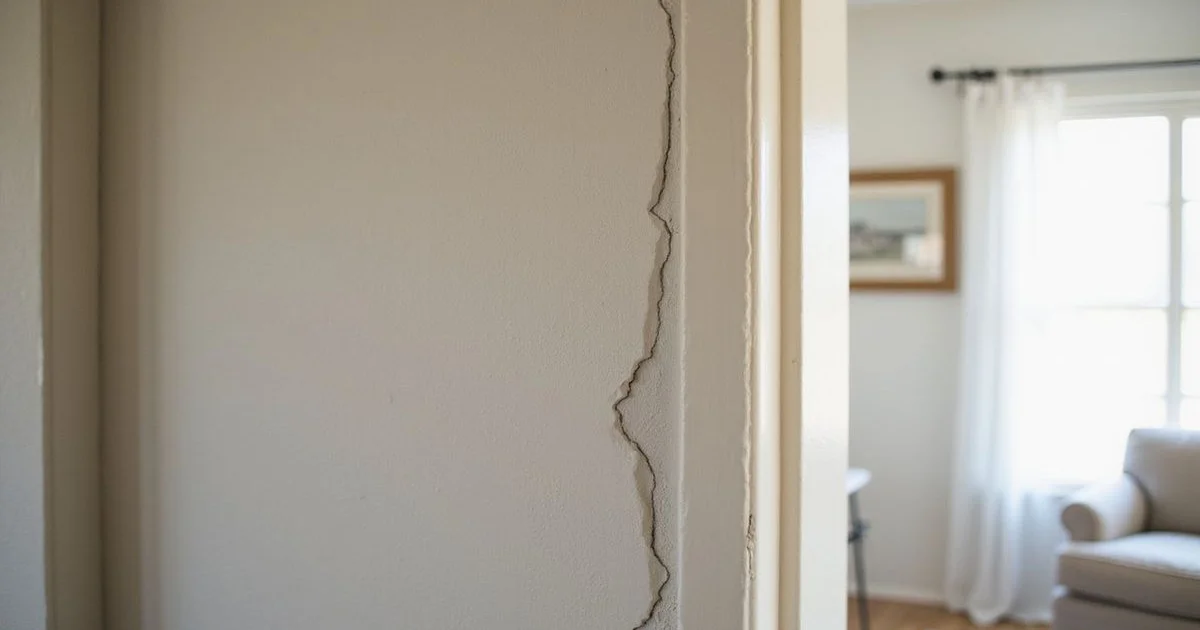
Location does more work than width
Inside a house, where a crack is tells you considerably more than how wide it is. That makes interior cracking one of the more useful foundation warning signs to record, provided you record the right things about it.
That runs against intuition. A wide crack looks alarming and a hairline looks benign. But a hairline running diagonally from a door corner, on a wall where the door has also started binding, is a more meaningful observation than a wider crack sitting along a taped seam with nothing else happening around it.
This guide covers which locations carry information.
Cracks at door and window corners
The pattern most associated with movement.
Openings interrupt the structure of a wall, so stress concentrates at their corners. When a building distorts, that is usually where the finish gives way first, producing a crack running upward and outward at roughly 45 degrees.
What makes it more significant: several on the same elevation, growth since you first noticed it, a door on that wall binding on one edge, and a corresponding exterior crack in roughly the same area.
Cracks along taped seams
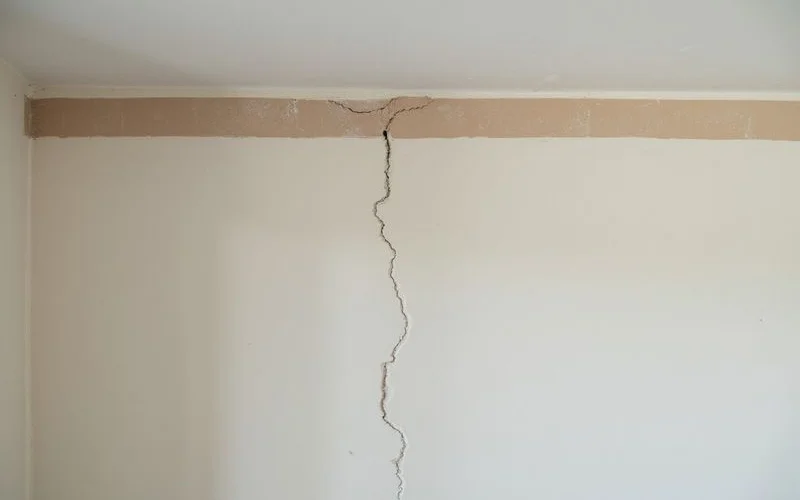
Drywall sheets are joined with tape and compound, and that joint is the weakest line in the assembly.
Seam cracks appear in perfectly sound houses in response to seasonal humidity change, framing shrinkage as timber dries over the first years, and normal building movement.
A straight hairline following an obvious seam line, particularly near a ceiling, is usually cosmetic. It is worth photographing and watching, not worth panicking about.
Cracks that cross a corner
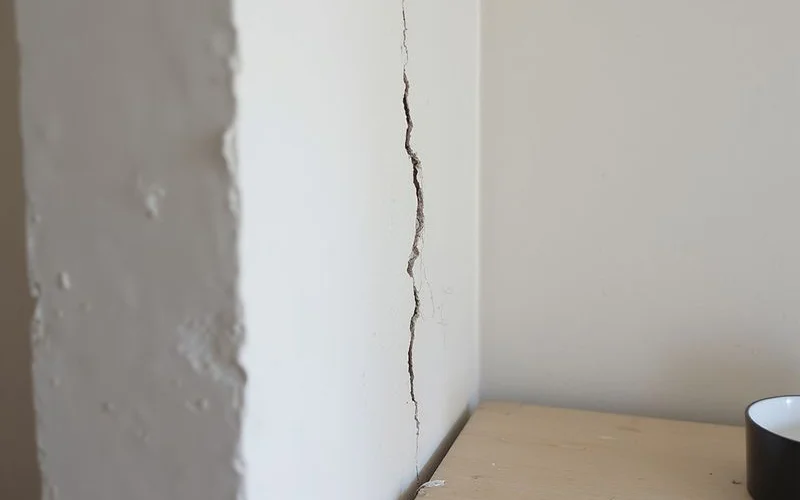
A crack that continues around a wall corner onto the adjoining surface is worth noting specifically.
Finishes are discontinuous at corners, so a crack carrying across one suggests the movement behind it is affecting more than a single wall plane. That is a structural signal rather than a finish one.
Plaster in older homes
In Lakewood, Oak Cliff, and other pre-war Dallas neighborhoods, interior walls are frequently plaster over lath rather than drywall.
Plaster is more brittle and reports movement earlier and more dramatically. A house with plaster cracking is not necessarily worse off than one with drywall cracking; it is reporting at a lower threshold.
Plaster also reflects its own age and history: keying failure, previous patching, and lath movement all produce cracks with nothing to do with the foundation.
Ceiling and horizontal cracking
Cracks along the junction of wall and ceiling, and horizontal cracks partway up a wall, are worth recording. Horizontal cracking in particular can indicate lateral force on a wall rather than vertical movement, which is a different mechanism.
What appearance alone cannot establish
It cannot establish elevation difference, which is what defines differential movement. It cannot establish progression without an earlier reference point. It cannot distinguish settlement from heave. It cannot separate movement from humidity, framing shrinkage, or original construction.
There is no crack width that decides the question, despite how often a specific number gets quoted. Change matters more than width, and context matters more than either.
What to document
- Location, direction, and width at the widest point, with something for scale
- Whether the crack starts at an opening
- Whether it crosses a corner onto the adjoining wall
- Whether it has grown, and over what period
- Dated photographs, repeated across a season
If you are deciding whether a particular crack needs sealing or something more, our guide on cosmetic crack repair versus structural repair covers the distinction.
The next step
Interior cracking is most useful read alongside an elevation survey, because the survey establishes whether there is measurable movement behind what you are seeing.
Standard homeowner evaluations carry no fee, and you keep the written findings whether or not repair turns out to be warranted.