

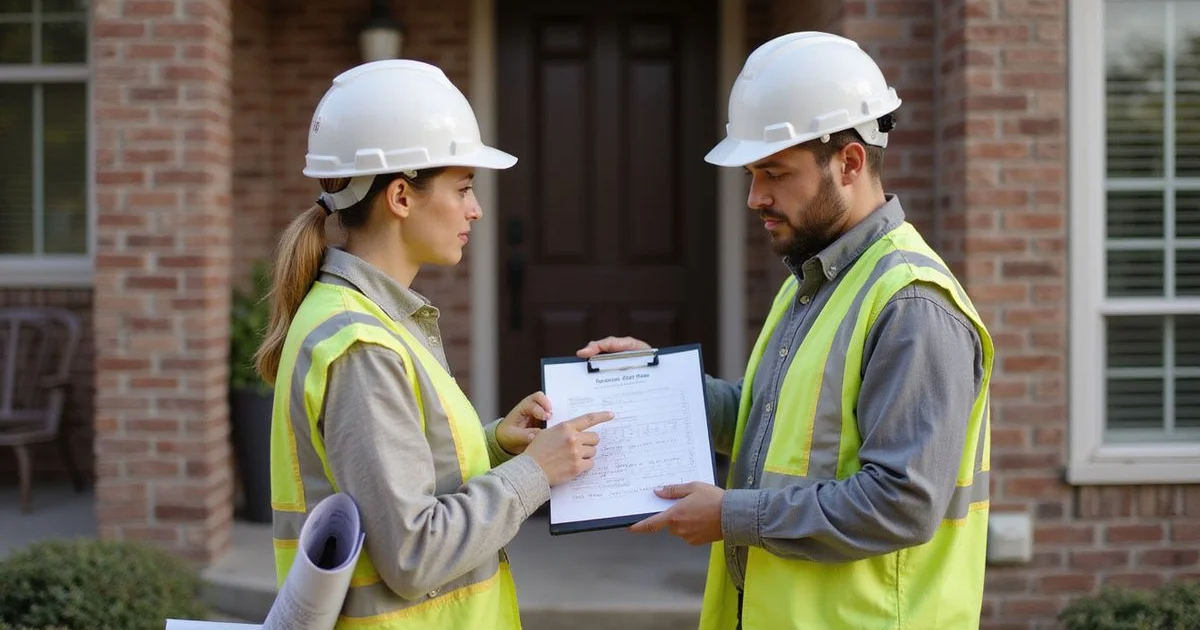
Two different products
Homeowners frequently ask which one they need, as though these were competing versions of the same service. They are not.
A contractor evaluation documents the current condition of your foundation and specifies a scope of work to address what was found. It is performed by the company that would do the repair.
A structural engineering assessment is an independent professional opinion on the structure, performed by a licensed engineer with no commercial interest in whether repair happens.
Different outputs, different purposes, different situations.
What a contractor evaluation provides

A properly performed foundation evaluation includes a digital manometer elevation survey across the floor plan, a visual distress survey inside and out, review of site conditions and history, and crawlspace inspection where applicable.
The output is written findings and, where repair is warranted, an itemized scope with pier locations, system, access, permits, restoration, exclusions, and warranty.
The strength is practical specificity: what to do, where, and what it costs. The limitation is structural: the party producing it also benefits if you buy it. That conflict is manageable when the evaluation is built on measurement you can inspect. It does not disappear.
What an engineering assessment provides

A licensed engineer evaluates the structure and issues an opinion, often as a stamped letter or report. Depending on the engagement, that can include an opinion on condition, a recommendation on whether repair is warranted, and in some cases a specified repair design a contractor then bids against.
The strength is independence. The engineer is paid for the assessment regardless of the conclusion, so recommending no repair costs them nothing.
The limitations: it costs money, it takes longer to arrange, and an engineer does not perform the repair. You still need a contractor afterwards.
Side by side
| Contractor evaluation | Engineering assessment | |
|---|---|---|
| Performed by | The repair company | A licensed engineer |
| Typical cost | Often no fee for homeowners | A professional fee applies |
| Output | Findings plus an itemized scope | Independent opinion, sometimes a specified design |
| Independence | Commercial interest in the outcome | No stake in whether repair happens |
| Turnaround | Usually days | Often longer |
| Performs the work | Yes | No |
| Weight in a dispute | Moderate | High |
When a contractor evaluation is enough
For a large share of straightforward residential situations, it is. You have noticed symptoms, you want to know whether there is measurable movement, and you want to know what addressing it would involve.
An evaluation built on an elevation survey answers all three, gives you documentation you keep, and frequently ends with a recommendation to monitor rather than repair.
When to bring in an engineer
- Real estate transactions. An independent opinion carries weight with buyers, sellers, and lenders that a contractor’s does not.
- Disputes. Between neighbours, with a previous contractor, or with an insurer.
- Lender or insurer requirements. Sometimes a stamped opinion is simply required.
- Complex or unusual structures. Significant additions, unusual framing, multi-level construction, or conflicting prior opinions.
- Conflicting proposals. When two contractors disagree substantially and you want a tiebreaker with no stake in the answer.
Our guide on when to get a structural engineer instead covers these scenarios in more detail.
How they work together
The sequence that works well on complex jobs: engineer assesses and specifies, contractors bid against that specification, engineer verifies the completed work.
That produces genuinely comparable bids, because everyone is pricing the same defined scope rather than proposing their own. It also produces a documentation package a future buyer’s advisor will take seriously.
What neither one replaces
Neither replaces an on-site examination of your specific property. Not a soil map, not a photograph, not a neighborhood generalization, and not a page like this one.
We will tell you directly when your situation calls for an engineer rather than us. That is not generosity; it is the only position consistent with how we describe our own work everywhere else on this site.