

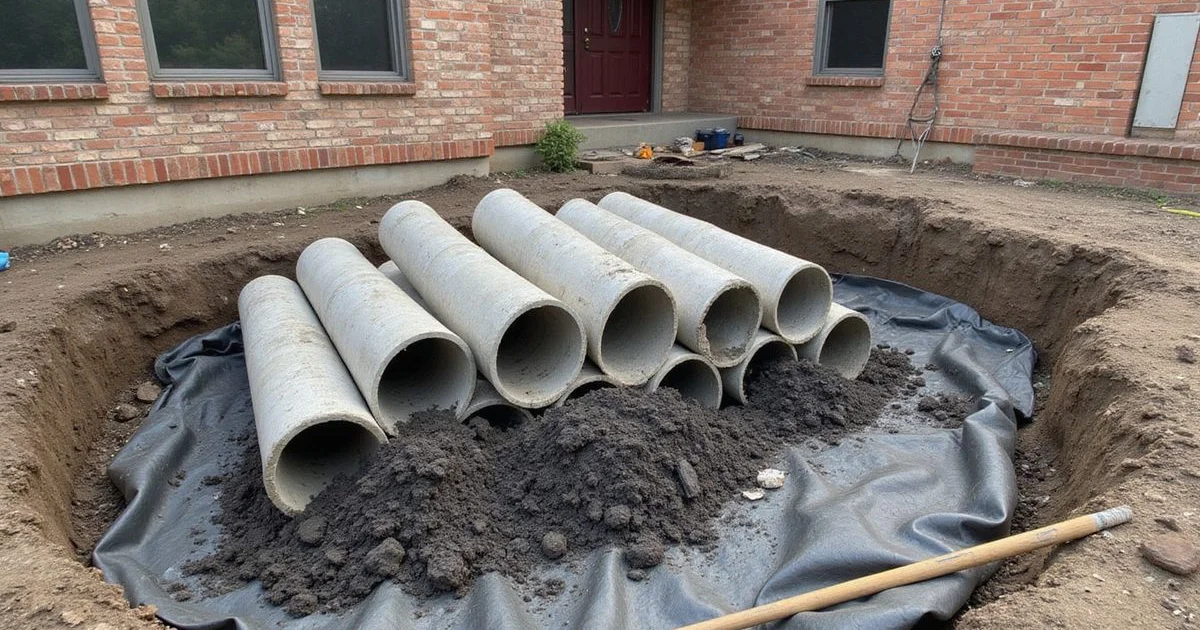
What a pressed concrete piling is
A pressed concrete pier is built from precast concrete cylinders, hydraulically forced into the soil one after another to form a continuous column beneath the foundation.
The press seats against the grade beam and uses the weight of the structure as the reaction. Each cylinder is pushed down, the next is placed on top, and the sequence continues until the column meets material capable of carrying load.
The result is an interlocking stack rather than a single element, which is a genuine engineering difference from a steel pier and shapes both its strengths and its limits.
How the column behaves
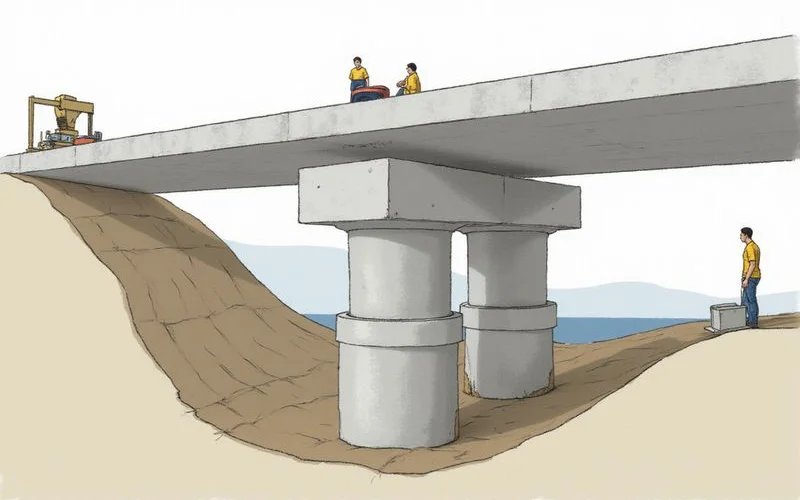
Concrete is excellent in compression, which is precisely the load a pier carries. A stack of cylinders bearing on competent material transfers building load efficiently.
The constraint is depth. As the column lengthens, friction along its sides accumulates, and because a concrete cylinder has a larger cross-section than a steel section, it accumulates faster. At a certain point the press cannot advance the column further even though it has not yet reached the target bearing material.
That is the practical reason pressed concrete is typically specified where adequate bearing is reachable at moderate depth, and steel where it is not.
Drilled concrete piers
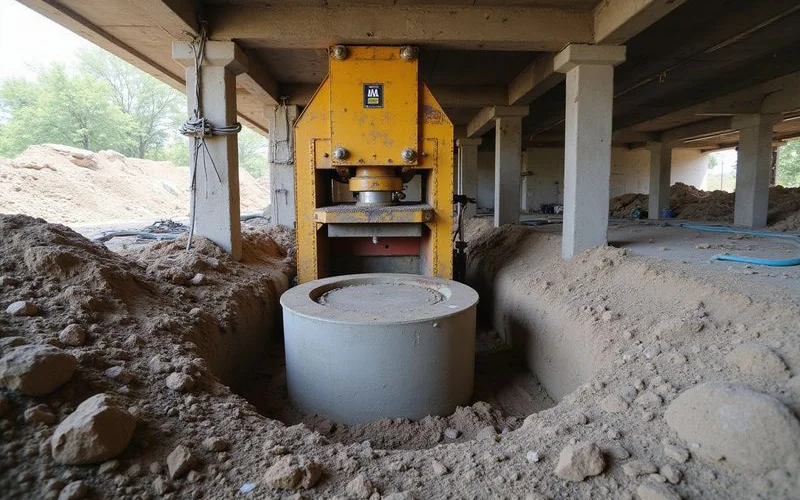
A different concrete approach: a shaft is drilled to the target depth, reinforcement is placed, and concrete is poured in situ to form a monolithic pier.
Drilled piers are most familiar as original construction, since a great many North Texas homes were built on them. As a repair method they appear less often in residential underpinning, largely because drilling equipment access around an existing house is difficult and the concrete needs curing time before it can take load.
Where they are used, the advantage is a single continuous element sized to the design load rather than a stack of standard cylinders.
When concrete is specified
- Competent bearing material is reachable within the system’s practical depth range
- Loads at the pier locations are within its capacity
- Site conditions suit the method
- The economics favour it, which they often do
None of that is a compromise. A pressed concrete pier reaching adequate bearing is a sound repair. The failure mode to avoid is one that stopped short of adequate bearing and got recorded as refusal anyway.
Limitations, stated honestly
Depth capability is the main one. Where bearing sits deep, a pressed system may not reach it.
Sensitivity to installation quality. The cylinders need to stack in reasonable alignment. A column that has wandered off vertical does not carry load as designed, and this is largely down to the crew.
Premature refusal is harder to detect. A column can stop advancing because of friction rather than because it has reached bearing, which is exactly why installation records and pressures matter.
Not suited to every load. Concentrated loads may call for a different system.
Why concrete remains widely used in Dallas
Pressed concrete has been the workhorse of North Texas residential underpinning for decades, and that is not inertia. Across large parts of Dallas County, competent bearing material sits within the depth range a pressed system comfortably reaches. Where that is true, a concrete pier does the same structural job as a steel one at a lower price, and paying for depth capability you do not need is not value.
The material is also well suited to the loading. A residential pier carries a compressive load, which is precisely what concrete handles best. There is no tension in the column under normal service conditions, so the absence of continuous reinforcement through the stack is less significant than it first sounds.
What changes the calculation is site variability. Where a property sits over deeper or less reliable profiles, a pressed system may run out of range before it finds bearing. That is a site condition rather than a flaw in the product, and it is exactly the judgement the evaluation is meant to inform.
How installation quality shows up later
Two crews can install the same product to meaningfully different standards, and the difference is invisible once the trenches are closed.
Alignment matters most. The cylinders need to stack close to vertical. A column that has wandered off plumb carries load eccentrically, and eccentric loading on a stacked element is not something you want underneath a grade beam.
Cleanliness of the excavation matters too. Debris and loose spoil at the base of the hole compromise the seating of the first cylinder.
Neither of these is visible in a finished project. Both are visible in the installation records and in the pressure readings taken as the column advanced, which is one more reason to ask for the log rather than assume it exists.
What to look for on a proposal
The system named explicitly, the depth approach described, confirmation that depth and pressure are recorded per pier, and a statement of how premature refusal or obstructions are handled.
If a proposal specifies concrete purely because that is what the company installs, and the reasoning is absent, ask what about your site conditions makes it the right choice. Our foundation repair methods page covers the selection logic, and steel piers versus concrete piers sets the two systems side by side.