

The mechanism is moisture, not force
The image most people have is of roots pushing against a foundation and cracking it. That does happen occasionally, mostly to flatwork and shallow footings, and it is why root barriers sit alongside grading and subsurface work in our drainage solutions.
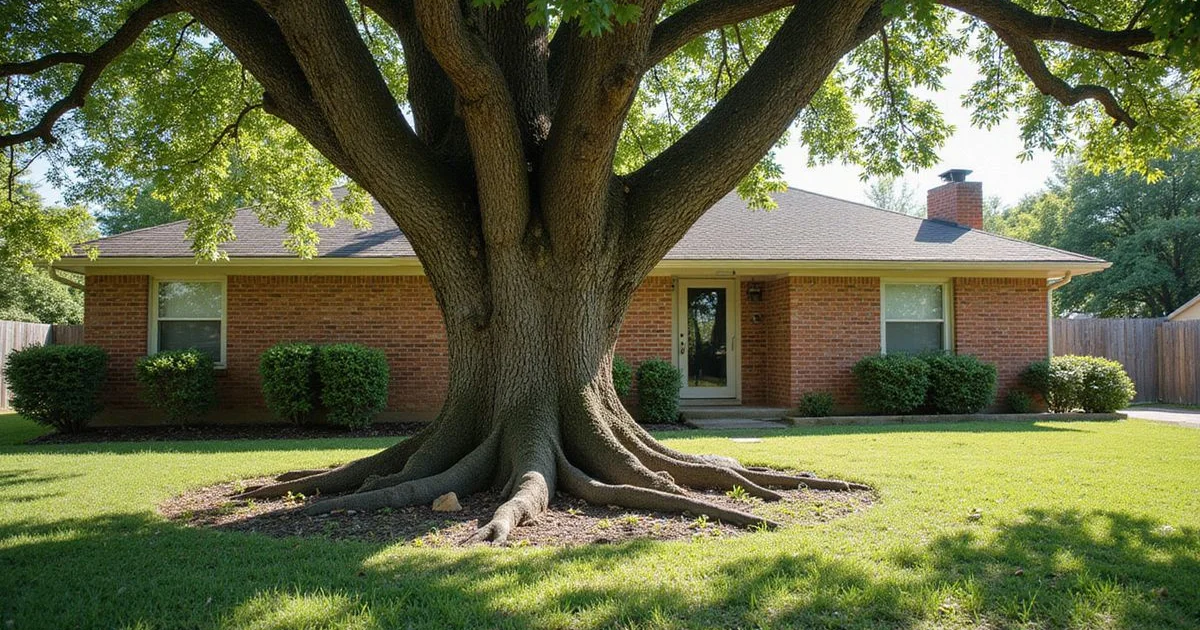
In North Texas, the far more common and more consequential mechanism is different. A mature tree draws a large volume of water out of the soil within its root zone, particularly through a hot dry summer. In expansive clay, soil that loses moisture shrinks.
So the tree is not pushing the house. It is drying the ground the house sits on, unevenly, on one side.
Why unevenness is the problem
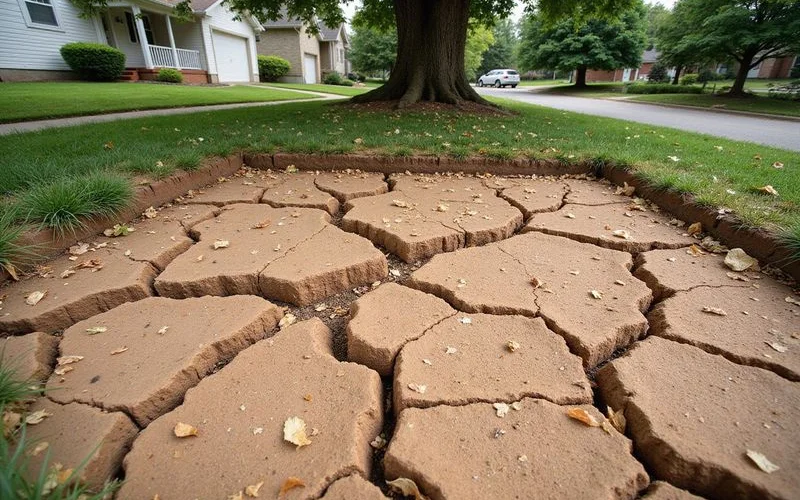
A house sitting on soil that dries uniformly settles uniformly, which does very little damage.
A house with a mature pecan on the west boundary and irrigated beds on the east has one elevation contracting while the other does not. That differential is what produces the diagonal cracking, binding doors, and sloping floors that bring people to a page like this one.
It is why the low corner on an elevation survey so often sits on the tree side of the property.
Trees common in Dallas
Live oaks, post oaks, pecans, elms, hackberries, and cottonwoods all have significant water demand and extensive root systems. Crepe myrtles and smaller ornamentals draw far less.
Root systems typically extend well beyond the canopy, which surprises people. The visible spread of the branches is not the extent of the roots, and in clay soil the roots will follow moisture wherever it is, including toward an irrigated bed beside a foundation.
What a root barrier does
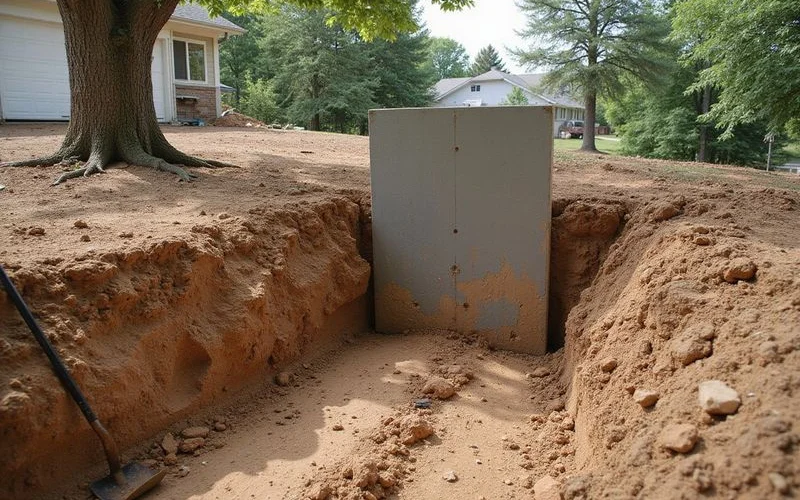
A barrier panel, usually HDPE, is installed vertically in a trench between the tree and the structure, deep enough to intercept the root zone that would otherwise extend under the foundation.
Roots encountering the barrier grow downward and outward around it rather than into the soil beside the grade beam. The tree keeps growing; it just stops drawing moisture from the specific area that matters.
Depth and length are set by the species, its mature root habit, and the geometry of the site. A barrier that is too shallow or too short simply gets routed around.
Barrier versus removal
A barrier keeps the tree. For most homeowners with a mature specimen shading the house, that is the outcome they want, and mature trees are a genuine asset in an established Dallas neighborhood.
Removal has its own risk. Soil that has been dried by a tree for years can take moisture back on once the tree is gone, and clay that rehydrates swells. Heave after tree removal is a real phenomenon, which is why removal is not an automatically safer choice.
Removal is sometimes right. A tree with structural problems of its own, a species genuinely unsuitable for its position, or a case where a barrier cannot be installed for site reasons. That is a conversation worth having with an arborist as well as with us.
Planting sensibly
If you are planting rather than managing an existing tree, plan for mature size rather than nursery size. Large canopy species need real separation from a structure; small ornamentals need much less.
Species-specific advice from an arborist beats any general rule, particularly since mature dimensions vary widely even within a genus.
How this fits with drainage
Root barriers sit within the broader business of managing soil moisture around a foundation, alongside grading, roof runoff management, and subsurface drainage. Our guide on how drainage affects your foundation covers the framework.
And as with everything else here: a barrier is a preventive measure. Where an evaluation has documented actual movement, structural repair is the corrective work, and the barrier is what stops the condition recurring afterwards.