

Start by watching the water
Before choosing a system, work out where the water actually is. The answer determines everything else.
Walk the property during or just after heavy rain. Note where water pools on the surface, where the ground stays saturated for days afterwards, which direction surface flow travels, and where it ends up in relation to the house.
Surface water and subsurface water are different problems, and installing the wrong system for your situation is an expensive way to discover that.
How a French drain works
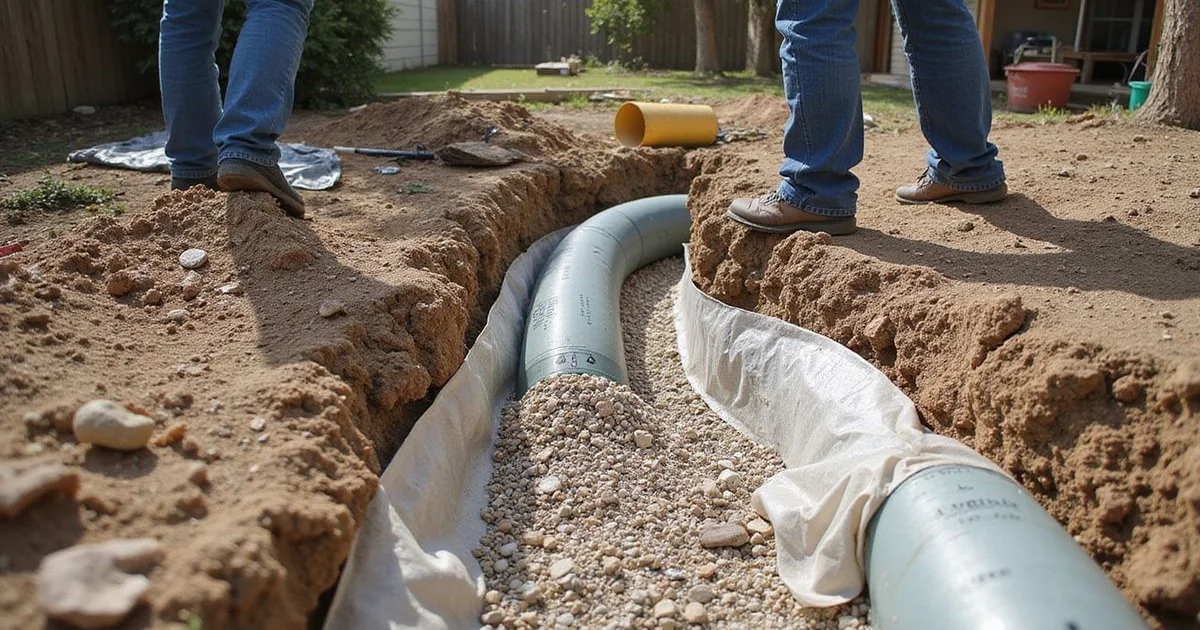
A trench is excavated along the line where water needs collecting. It is lined with geotextile filter fabric, a perforated pipe is laid in it, and it is backfilled with clean gravel before the fabric is folded over the top.
Water in the surrounding soil moves into the gravel, enters the pipe through its perforations, and is carried by gravity to a discharge point.
The filter fabric is the part people skip and should not. Without it, fine soil particles migrate into the gravel and eventually into the pipe, and a silted drain is an expensive trench that does nothing.
How surface drainage works
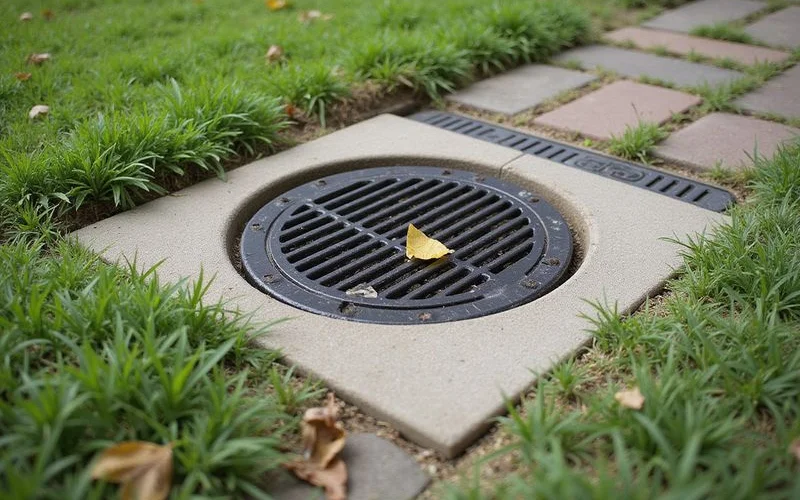
Surface systems collect water before it soaks in.
Catch basins are boxes set flush in low points, with grated tops, connected to solid pipe. Water running across the surface drops in and is carried away.
Channel drains are linear versions, used along patio edges, driveways, and at garage thresholds.
Swales and regrading shape the ground itself to route surface water along an intended path rather than letting it find its own.
Solid pipe rather than perforated is used downstream of a surface collection point, since the objective is to carry water away rather than let it back into the soil.
Which conditions favour which
| Condition | Usually points to |
|---|---|
| Water visibly pools on the surface | Catch basins and solid line |
| Ground stays saturated for days | French drain |
| Slope above the house shedding water toward it | French drain across the slope |
| Runoff crossing a patio or driveway | Channel drain |
| Grade falling toward the house | Regrading first |
| Roof runoff concentrated at a corner | Downspout extensions |
| Both surface pooling and saturated ground | Both, addressing different parts |
Most real properties are a combination, and a sensible design uses the appropriate tool at each point rather than running one system everywhere.
Discharge: the constraint that shapes the design
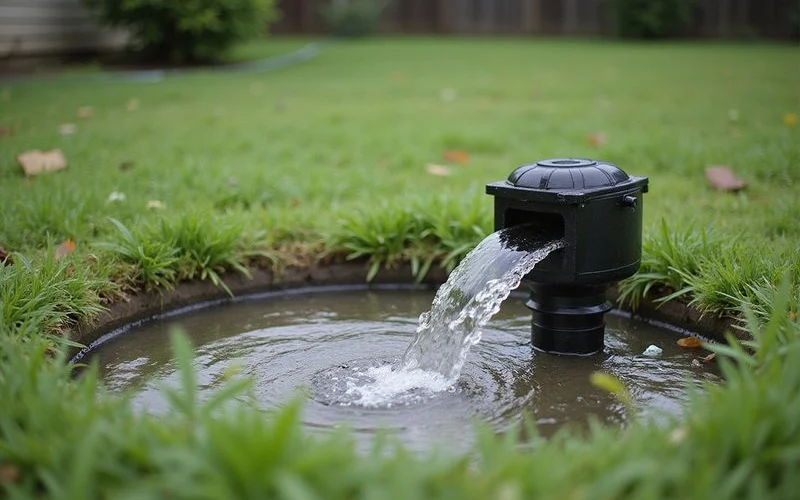
Every system needs somewhere for the water to go: lower than the collection point, on ground you control or into a lawful outlet, and not creating a problem on a neighbouring property.
This limits more designs than any other factor. On a sloped Oak Cliff lot it is usually straightforward. On a flat lot in Plano or Garland, the viable outlet can be a long run from the problem, and occasionally a sump and pump is the only workable answer.
We confirm the discharge before quoting the run. A drain with nowhere to go is just a trench that holds water against your house.
Cost drivers
- Linear footage and depth. The largest single factor. Deep subsurface work through clay costs considerably more per foot than shallow surface work.
- Distance to a viable outlet. Long runs add both pipe and trench.
- Surface restoration. Turf, beds, and hardscape crossed by the trench have to be reinstated. Cutting and replacing a driveway section is a significant line.
- Site access. Whether machinery can reach the work, or whether it is hand-dug.
Surface systems are generally cheaper per linear foot because they are shallower. That is not a reason to install one where the problem is subsurface.
Maintenance
Both systems need it. Catch basins fill with leaves and silt. Outlets get overgrown or buried in mulch. Pop-up emitters jam.
None of it is difficult, but it does have to happen. At handover we show you where the access points are and what clearing them involves, and we document the as-built run so a future owner is not guessing about what is buried in the yard.
Before installing anything
Check the free items first: clear the gutters, extend the downspouts, re-establish grade where it has flattened, and clear any existing drain outlets. A meaningful share of drainage complaints resolve there.
Where water still collects against the structure afterwards, that is when a designed system earns its cost. Our drainage solutions page covers how we scope and document the work, and how drainage affects your foundation explains why any of it matters structurally.