

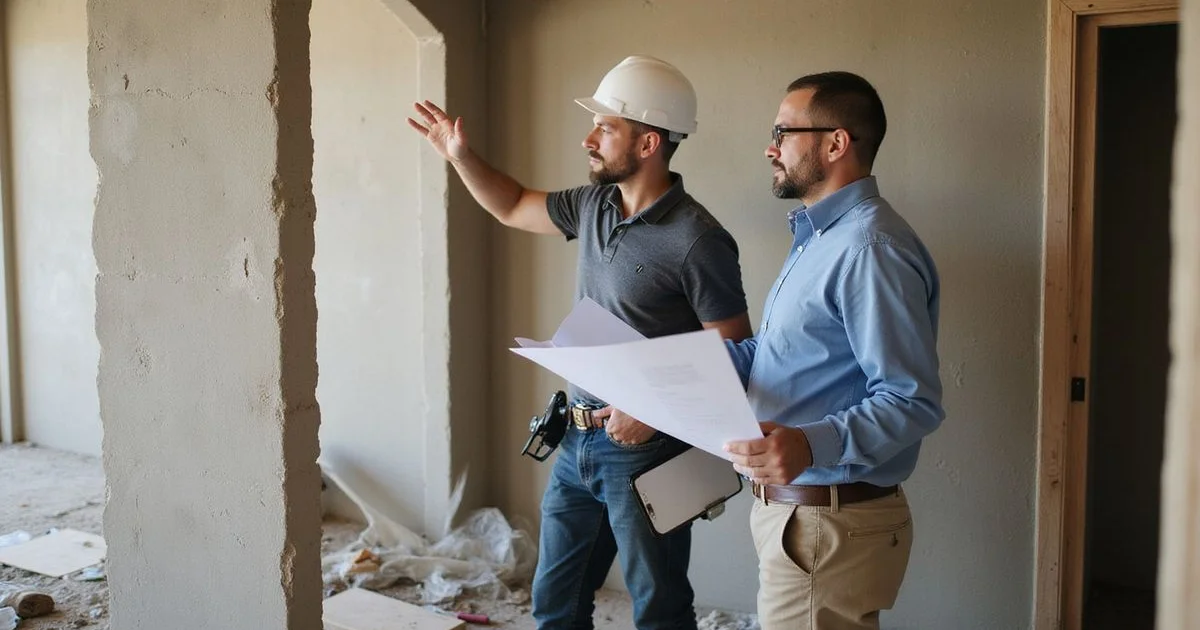
The confusion is mostly vocabulary
Search for foundation help in Dallas and you will find companies advertising house leveling, foundation repair, foundation leveling, house stabilization, and underpinning, frequently describing work that overlaps substantially.
That is not primarily deception. It is an industry where the same underlying work gets marketed under whichever term customers are searching for.
The practical consequence is that the heading on a proposal tells you very little. The scope tells you everything. Expectations matter just as much, which is why what house leveling can and cannot fix is worth reading alongside this.
What each term usually emphasises
House leveling emphasises elevation recovery: raising a structure back toward a target profile and holding it there. The visible result is floors closer to level and doors that work again.
Foundation repair is the broader category. It includes leveling, and it also includes stabilizing a foundation without recovering elevation, correcting drainage, coordinating plumbing repair, replacing failed framing in a crawlspace, and controlling crawlspace moisture.
So leveling is a subset, most of the time. The complication is that plenty of companies use the terms interchangeably regardless.
Where the work genuinely differs
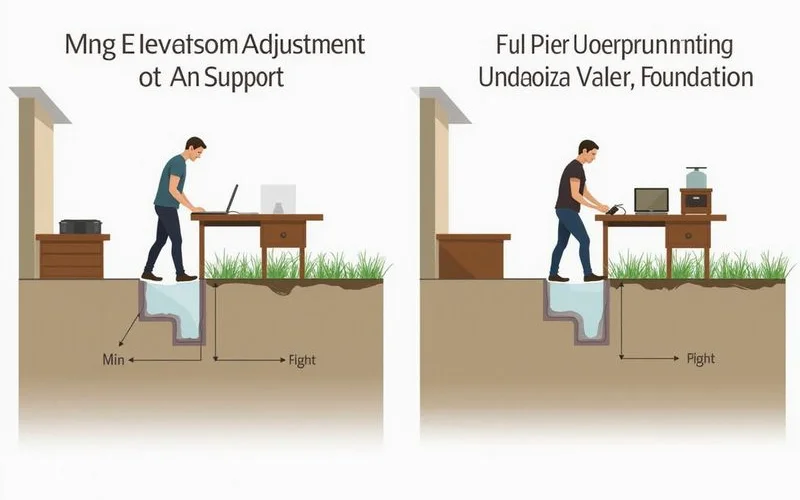
Consider two pier-and-beam projects.
Project A: existing piers are sound but the structure has settled. Supports are adjusted and shimmed to a monitored target. That is leveling in the narrow sense, and it is a relatively contained job.
Project B: piers have failed, a girder has rotted at a bearing point, joists are deflecting, and the crawlspace has been damp for years. Adjusting supports would achieve nothing durable. The work is new footings and piers, girder replacement, joist sistering, and moisture control. Elevation recovery is part of it but not the point of it.
Both might be advertised as house leveling. They are not remotely the same purchase.
When leveling alone is appropriate
- The supporting elements are sound and simply need adjustment
- No structural members have failed
- The cause of the movement has been identified and addressed
- Measured variance is meaningful enough to be worth recovering
- The structure can tolerate the elevation change without unacceptable finish damage
When broader repair is needed
- Structural members have failed and need repair or replacement
- Piers have failed or spacing was always inadequate
- An active cause remains: a plumbing leak, a drainage problem, an aggressive tree
- Crawlspace moisture has damaged framing
- Elevation recovery would need permanent new support to hold
When neither is the right answer
Sometimes the honest recommendation is to monitor.
Where measured variance sits within normal tolerance, movement is not progressing, and finishes have long since adapted, aggressive intervention can cause more damage than the condition was causing. That is particularly true in older Dallas homes with original plaster and windows.
We document that recommendation in writing when the data supports it, along with what to watch and what would change it.
How the evaluation decides

An evaluation produces the elevation profile and, on a raised foundation, a crawlspace assessment of every component in the load path.
From that, three questions get answered: is there meaningful variance, is anything structurally failed, and is a cause still active. The answers determine the scope, and the scope determines which word goes on the heading.
What to read on a proposal
Ignore the title. Read:
- What is being installed, and where
- What elevation target is agreed
- What holds the new position permanently
- Whether carpentry, drainage, or plumbing work is included
- What is excluded
- What documentation you receive
Two proposals with different headings and identical scopes are the same job. Two with the same heading and different scopes are not. Our house leveling page sets out how we scope the work and what the written document contains.